The order
She sees it. She says it. It types. She approves.
The order never changes, and it never will.
One
She sees it.
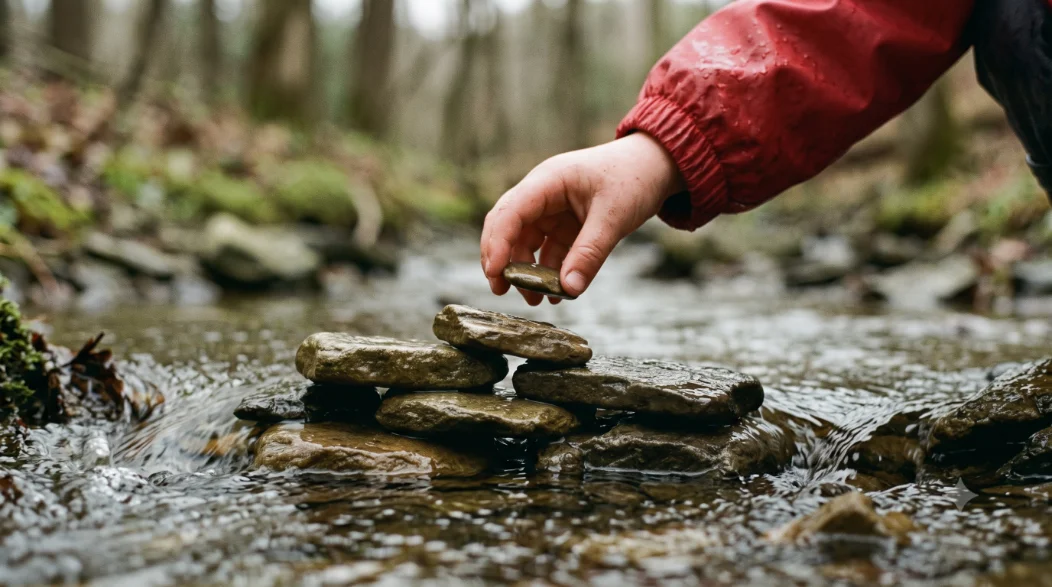
One photo, twenty seconds of voice at the creek: “Sami kept rebuilding the dam, tested every rock before placing it.” Hands free again in half a minute.
Two
She says it.
Her words, not a form. What she noticed and why it mattered, in the moment, while it's still fresh.
Three
It types.
Two readable sentences, with the skills the moment might show. It works only from what she captured. It never invents a detail it didn't hear or see.
Four
She approves.
At lunch she fixes a word, removes a tag she disagrees with, and approves. Or discards it. Nothing reaches a family without her sign-off. The AI has no publish button.
The AI records what the teacher tells it; it doesn't decide what the story is. What the details mean, and whether a family ever sees them, is always a person's call.
One real example
What she said · 9:04, at the creek
“Sami kept rebuilding the dam, tested every rock before placing it, and got Theo to hold the big one.”
Twenty seconds of speaking became the evening's write-up. In her words, under her name. She removed one suggestion she disagreed with.
Skills
Evidence. Never a score.
Educators have always known that dam-building is engineering and rope swings are risk assessment. The hard part was writing it down. Grove keeps a map of how outdoor activities connect to skills, and to each province's early-learning expectations.
When the AI suggests a skill, it's proposing a match from that map, based on what the teacher described. The teacher confirms or removes it. Over a term, those confirmed moments add up to real evidence of growth. Never a score, never a ranking, never a comparison to other children.
If a story has no entry yet, that isn't a gap that gets flagged. It just means that chapter hasn't been written.
The lines
The lines we don't cross.
Not settings that can be toggled later. Breaking them would mean rebuilding the product.
Photos stay inside your school
No photo of a child is ever sent to an outside AI company. The work happens inside the same protected space where your school's data already lives.
Nothing trains on your children
Photos, voice notes, and observations are never used to teach a model. Not ours, not anyone's.
A teacher reads every word first
Every draft observation, digest, and Record narrative is reviewed, edited, and approved by a teacher before a family sees it.
It never judges a child
It suggests skills a moment might show. It never grades, ranks, profiles, or predicts anything about a child. There are no scores anywhere in Grove.
Every draft leaves a trail
What the AI drafted, what the teacher changed, and who approved it are kept in an audit log a school can review at any time. The AI is never the author of record.
Consent is per child, per use
Families decide what the AI may touch. An opt-out is honoured at the moment of capture, automatically. It never depends on a teacher remembering.
A policy you can hold us to
Grove's AI-use policy is part of every school agreement: what the tool does, what it will never do, and how to report a concern. Changes to how it writes are tested for accuracy and bias before release, and schools are told first.
Questions
Fair questions.
What the tool touches, what happens when it's wrong, and who you can talk to.